
Success in data science isn’t just about knowing how to write a linear regression model; it’s about maintaining what psychologists call “The Flow.” For a student working on a Linux distribution like Ubuntu, Fedora, or Arch, that flow is often shattered by a terminal screen full of red text. Science tells us that it takes nearly 23 minutes to fully refocus after a significant distraction. In the world of Python programming, that distraction usually comes in the form of a “ModuleNotFoundError” or a “Segmentation Fault.”
When you are deep into your academic research, the last thing you want to do is fight with your operating system’s kernel or path variables. However, many students find that managing complex software dependencies while trying to maintain academic excellence is a heavy burden that eats into their sleep and productivity. This is exactly where professional assignment help from the experts at myassignmenthelp becomes a strategic resource, allowing you to focus on learning the core mathematical concepts while seasoned professionals help guide you through the technical hurdles of project documentation and code optimization.
Why Linux and Python Sometimes Clash
Linux is the native environment for data science. Most of the world’s supercomputers and servers run on it, which is why libraries like Pandas, NumPy, and TensorFlow are built to perform best on Linux. But for a student, Linux is a “double-edged sword.” Unlike Windows or macOS, where installers often bundle every single dependency together in a “hidden” way, Linux expects you to be the architect of your own system.
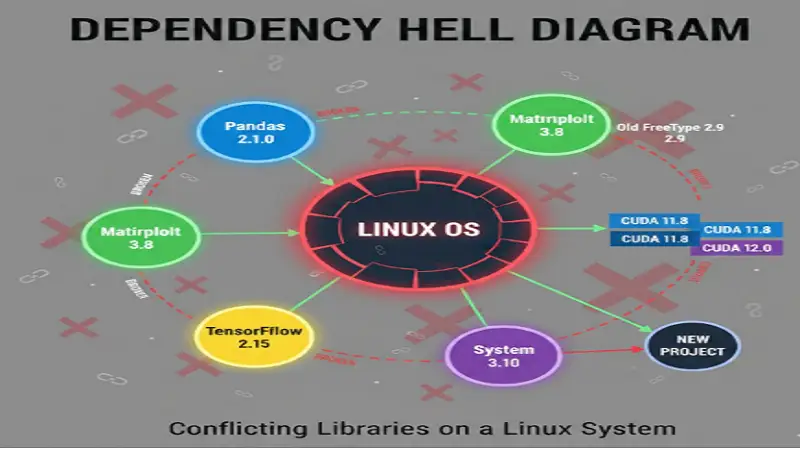
Most common errors occur because of “Dependency Hell.” This is a technical term for a situation where one library (like Matplotlib) requires a specific version of another library (like FreeType), but your system already has a different version installed for a different app. On Linux, Python isn’t just a tool you installed; it is often a core part of the OS itself. If you change the wrong file, you might not just break your homework—you might break your desktop environment.
 Resolving the “ModuleNotFoundError” at the Root
The most frequent headache for students is the ModuleNotFoundError. You have typed import pandas as pd, but the terminal insists it doesn’t exist, even though you just installed it. On Linux, this is almost always a “Path” issue. Linux has multiple “bins” (binary folders) where it stores executable programs.
The Fix: You must stop using sudo pip install. When you use sudo, you are telling the computer to install the library for the entire operating system. This often leads to version conflicts. Instead, the “Science of Focus” suggests isolating your work.
- Create a Workspace: mkdir data_project && cd data_project
- Build a Virtual Environment: python3 -m venv env
- Activate the Shield: source env/bin/activate
Once activated, your terminal will show (env) next to the prompt. Now, any library you install stays inside that folder. This prevents your assignments from “bleeding” into each other.
Handling C-Extension and Compiler Errors
Data science libraries are unique because they aren’t just written in Python. To be fast enough to process millions of rows of data, libraries like Scikit-Learn or PyTorch are built on C++ and Fortran. If you see an error mentioning gcc, cmake, or python.h, it means your Linux system is missing the “build-essential” tools required to compile that code.
Before you panic about your upcoming submission or spend all night browsing obscure forums, remember that high-level technical support is a valid part of the learning process. If you are struggling with complex algorithms or broken environment configurations that prevent you from starting your work, seeking Programming Assignment Help can bridge the gap between a failing grade and a deep, practical understanding of how the code actually functions under the hood.
The Science of “Dependency Trees”
To rank well in your class—and on Google—you need to understand the “Tree.” Every Python library has parents and children. For example, Seaborn is a child of Matplotlib. If Matplotlib is broken, Seaborn will never load.
On Linux, you can use the command pip check to see if you have any broken dependencies. It is like a medical check-up for your code. If the check-up shows errors, the best way to fix it isn’t to delete everything, but to use a requirements file.
- Create a file named requirements.txt.
- List your libraries: pandas==2.1.0, numpy==1.26.0.
- Run pip install -r requirements.txt.
This ensures that every time you open your project, the environment is exactly the same. Consistency is the key to scientific focus.
Managing Version Mismatches in 2026
As we move further into 2026, Python libraries are evolving faster than ever. A tutorial you found from three years ago might use code that is now “deprecated.” A common error students see is AttributeError: module ‘pandas’ has no attribute ‘append’. This isn’t because you did something wrong; it’s because the developers of Pandas decided that .append() was too slow and removed it in favor of pd.concat().
When you encounter these errors on Linux, use the grep command to search your files for the old code.
- Command: grep -r “.append” . This will show you every line in your project that needs to be updated to the modern standard.
The Choice: Conda vs. Pip on Linux
For 12th-grade students and university freshmen, the choice between pip and conda can be confusing. pip is the standard Python package manager, but conda (specifically Miniconda) is often better for data science. Why? Because conda is “language-agnostic.” It can install non-Python tools like the CUDA toolkit for your Graphics Card (GPU) without you having to touch your Linux system files.
If your assignment involves “Big Data” or “Deep Learning,” conda will save you hours of manual configuration. It creates a “bubble” where you can experiment with different versions of Python (like 3.9 for an old project and 3.12 for a new one) without them ever clashing.
The Psychology of “Help-Seeking” in Technical Fields
There is a scientific concept called the “Zone of Proximal Development.” It suggests that we learn best when we are challenged, but not overwhelmed. If a task is too easy, you get bored; if it’s too hard (like a broken Linux kernel or a bug you’ve chased for 10 hours), you experience “cognitive freeze.”
The most successful developers in the industry—the ones who rank #1 in their fields—know when to pivot. They don’t waste three days on a single error. They use documentation, community forums, and professional academic services to bypass the “grunt work.” This allows them to focus their brainpower on the actual data analysis and the “Why” behind the science, rather than the “How” of a broken install script.
Using “GDB” to Debug Persistent Crashes
Sometimes, your Python code might just say Segmentation Fault (core dumped). This is the most frustrating error on Linux because it gives no clues. To fix this, you can use gdb (the GNU Debugger).
- Run gdb python.
- Inside the debugger, type run your_script.py.
- When it crashes, type backtrace.
This will show you exactly which C-library caused the crash. It turns a “mystery” into a “math problem” that you can solve.
Conclusion: Building a Resilient Academic Workflow
Ranking on the first page of Google—and the top of your class—requires a combination of technical skill and the ability to find the right tools. To master Python data science on Linux, keep these four rules in mind:
- Isolation is Key: Always use virtual environments (venv or conda).
- Read the Bottom Line: In a Python error “Traceback,” the most important information is always the very last line.
- Audit Your Packages: Use pip list –outdated to see if your tools are holding you back.
- Value Your Time: Use professional resources when the technical hurdles stop you from actually learning the science.
Linux is a powerful ally for any student, provided you know how to speak its language. By mastering these “fixes,” you transform from a frustrated student into a capable data scientist ready for the challenges of 2026.
Frequently Asked Questions
Why do library errors occur more often on Linux than other systems?
Linux often uses a system-wide version of Python to run essential desktop functions. When users install new data science tools without isolation, version conflicts occur between what the operating system needs and what the specific project requires.
What is the fastest way to identify a broken dependency?
The most efficient method is to check the terminal “stack trace.” By reading the output from the bottom up, you can identify the specific module name and the type of mismatch—whether it is a missing file or an outdated function.
Can I run multiple versions of the same library for different projects?
Yes. By using virtual environments or containerization, you can create isolated “bubbles” for every project. This allows one folder to run an older version of a tool while another folder uses the latest release without any interference.
How do I fix an error that mentions “gcc” or “compiler” during installation?
These errors usually mean your system lacks the necessary build tools to translate raw code into an executable format. Installing a “build-essential” package through your distribution’s terminal manager typically resolves these configuration hurdles.
About The Author
Min Seow is a seasoned technical writer and academic consultant specializing in the intersection of open-source software and data science. With a passion for simplifying complex Linux workflows, Min collaborates with myassignmenthelp.services to empower students with the practical tools and debugging strategies needed to excel in modern computing environments.
See More: plugboxlinuxorg